
Concept, target group and business plan
The starting point is not the building but the concept. Which disciplines will you offer? Who do you want to reach: children, recreational athletes, competitors, corporate clients? The answers determine your space requirements, equipment, timetable and location.
- Disciplines: boxing, kickboxing, Muay Thai, MMA, grappling or a combination.
- Target groups: children and teenagers, recreational adults, a competition team, women-only classes, corporate training.
- Positioning: performance sport, fitness with combat sports elements, or both.
- Legal form and financing: clarify with a tax adviser and your bank before you sign any contracts.
Write a business plan, even if no bank asks for one. It forces you to calculate membership targets, running costs and the start-up period realistically. In Germany, funding programmes from federal and state governments and development banks are listed in the federal funding database (Förderdatenbank).
The market in figures
The demand is there. According to the 2025 membership survey of the German Olympic Sports Confederation (DOSB), boxing had exactly 88,388 club memberships on 1 January 2025, up 8.87 %. Kickboxing grew by 12.15 % to 37,200 memberships. Overall, organised sport in Germany counted around 29.3 million memberships.
The commercial market is growing too. According to the 2026 key figures for the German fitness industry from DSSV, Deloitte and DHfPG, around 12.36 million people trained in 9,647 fitness and health facilities at the end of 2025. A year earlier, there were 11.71 million members in 9,127 facilities. The message is clear: people pay to train. Your gym has to explain why they should do it with you.
Finding the right premises
The premises shape almost everything that follows. Do not sign a lease before you have checked these points.
Change of use and building law
The approved use of a property is recorded in its building permit. Turning a warehouse, office or shop into a gym is a change of use. The Cologne Chamber of Commerce (IHK Köln) puts it plainly: as a rule, a change of use requires a building permit. The details are set out in the building code of each federal state.
The IHK recommends clarifying before signing the lease which use has been approved for the premises, whether your use is permitted at that location and which procedure applies. According to the IHK, a change of use can apply even when nothing is rebuilt, simply because the rooms are used differently from what was approved. Allow time for the procedure. Talk to the building authority early and get the answer in writing.
Height, floor, noise
- Ceiling height: for rooms where employees work, the German technical rule ASR A1.2 sets minimum clear heights by floor area, for example 3.00 m for more than 100 m². A ring on a platform or hanging punchbags need extra headroom on top of that.
- Load capacity: rings, cages and punchbag frames transfer loads into the floor or ceiling at specific points. Have this checked by a structural engineer if needed, especially on upper storeys.
- Noise: punchbags, music and jumping drills create airborne and structure-borne noise. Find out who works or lives above and next to you.
- Sanitary facilities and ventilation: changing rooms, showers and toilets for the expected number of members, plus ventilation that can cope with full classes.
- Location: public transport links, parking, visibility from the street.
Registration, permits and insurance
The paperwork is manageable if you tackle it in the right order. Under Section 14 of the German Trade Regulation Act (Gewerbeordnung), anyone starting a fixed-location trade must notify the competent authority at the same time. Whether your gym counts as a trade depends on its legal form and what it offers. Check this with the trade office or your tax adviser.
- Trade registration with the trade office, where a trade applies.
- Tax registration with the tax office.
- Building permit for the change of use, if required.
- Music licence (GEMA) if music is played during training.
- Statutory accident insurer (Berufsgenossenschaft): businesses register with the responsible BG within one week of starting (Section 192 of Social Code Book VII).
For insurance, the overview from the Regensburg Chamber of Commerce (IHK Regensburg) is helpful. Business liability insurance covers damage caused to third parties by your business. According to the IHK, you should not go without it if your liability risk is high, and a martial arts gym carries that risk. Contents insurance protects your equipment against risks including fire, storm, hail, water damage, robbery, burglary and vandalism following a break-in. Employees are covered by statutory insurance against occupational accidents through the Berufsgenossenschaft. The IHK describes business interruption insurance as potentially very important, for example if losing the use of your premises would put the gym at risk.
Equipment and space planning
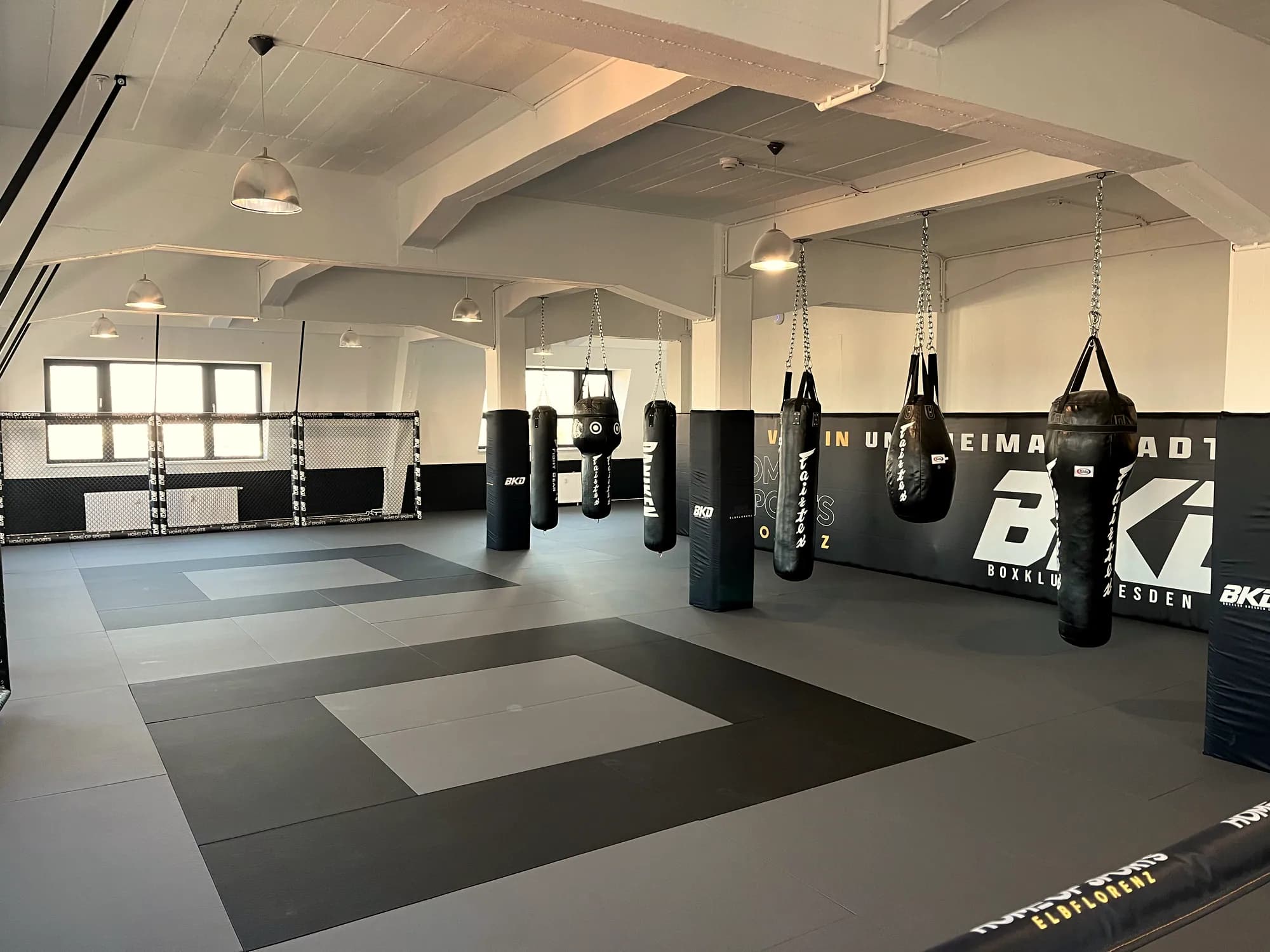
Plan the space in zones. Each zone has a purpose and its own requirements. This stops punchbag sessions and technique classes from getting in each other's way.
| Zone | Purpose | Planning question |
|---|---|---|
| Ring or cage | sparring, technique, events | Which main discipline? Platform or ground level? |
| Punchbag area | punching and kicking drills | ceiling or frame mounting, spacing, structure-borne noise |
| Mat area | technique, groundwork, classes | thickness, transitions, cleaning |
| Wall padding | protection on walls and columns | height, padding, branding |
| Strength and conditioning | strength and fitness | floor protection, distance from fighting areas |
| Changing rooms and showers | comfort and hygiene | number, ventilation, circulation |
| Reception | check-in, advice, trial sessions | line of sight to the training floor |
Whether you need a ring, a cage or both is a question your concept answers. Boxing, kickboxing and Muay Thai point to a ring, MMA to a cage. Dimensions, heights and rulebooks deserve a close look before you order.
- Decide what must be in place on day one and what can follow later.
- Build delivery times and installation dates into your schedule.
- Agree maintenance and warranty before you order.
- Think about branding: logos on the ring, walls and punchbags show up in every photo.
Team, timetable and memberships
A gym lives on its coaches. Look for qualifications, experience with beginners and children, and federation licences if your athletes are going to compete. Settle contracts and cover arrangements before you publish the timetable.
- Timetable: core classes in the evening, children's classes in the afternoon, open training for advanced members.
- Getting started: clearly described beginners' courses lower the barrier for newcomers.
- Memberships: simple options, clear terms and easy-to-understand cancellation rules.
- Software: check-in, class booking and billing in one system save time at reception.
- Safety: first-aid equipment, trained coaches, clear rules for sparring.
Marketing and opening
Start marketing before the premises are ready. If you already have a list of interested people on opening day, you start with full classes instead of empty mats.
- Set up a Google Business Profile with address, opening hours and photos.
- Publish a website with the timetable, coach profiles and a form to book a trial session.
- Show the build on social media: from the empty hall to the first sparring session.
- Collect interested people before opening, for example through a waiting list.
- Approach local schools, clubs and businesses about partnerships.
- Plan an opening day with open trial sessions and tours of the gym.
- After opening, gather feedback and adjust the timetable.
The checklist at a glance
| Phase | Tasks |
|---|---|
| 1. Concept | disciplines, target groups, positioning, business plan, financing |
| 2. Premises | check approved use, ceiling height, load capacity, noise, sanitary facilities, location |
| 3. Authorities | building authority, trade office where needed, tax office, Berufsgenossenschaft, music licence |
| 4. Insurance | business liability, contents insurance, business interruption if needed |
| 5. Equipment | zone plan, ring or cage, punchbags, mats, walls, installation date |
| 6. Team | coaches, contracts, timetable, membership options, software |
| 7. Marketing | Google profile, website, social media, waiting list, partnerships |
| 8. Opening | trial sessions, tours, feedback, first adjustments |
How Cachena Sport helps
Cachena Sport supports gyms from the empty room to the first round. We build boxing rings, MMA cages and wall padding to measure in our own workshop near Ulm, made in Germany, and install them on site. Founder Amer Osmanhodzic is a two-time European kickboxing champion and has worked in metal fabrication for more than 15 years. We have more than 500 projects behind us.
- Initial conversation
- Consultation and situation analysis
- Defining the facility
- Production in our own workshop
- Delivery and installation
- Handover and maintenance
We take care of planning, branding on canvases, ropes, corner pads, punchbags and wall padding, and maintenance. We give a 10-year warranty on the steel structures we manufacture ourselves; wear parts such as pads, ropes, mats, floors and coatings are excluded. We deliver across Europe.
This checklist does not replace legal, tax or building advice. The requirements of your local authorities and the current rules of the sports federations always take precedence. If bouts are planned, check the requirements for the ring or cage with the responsible federation before you buy.
Planning a project?
We advise you on your space and how you will use it – usually within one working day.
Martial arts gym fit-outSources
- DOSB: membership survey 2025, reference date 1 January 2025 (German)
- DOSB: new membership record in German sport (German)
- DSSV: key figures of the German fitness industry 2026 (German)
- DSSV: key figures of the German fitness industry 2025 (German)
- IHK Köln: building projects and change of use (German)
- IHK Köln: change of use explained briefly (German)
- German Trade Regulation Act, Section 14: duty to notify (German)
- Social Code Book VII, Section 192: employers' duty to notify (German)
- Federal funding database (Förderdatenbank, German)
- IHK Regensburg: insuring yourself and your business (German)
- ASR A1.2 room dimensions and movement areas (September 2013 edition, last amended 2022), provided by the Baden-Württemberg trade supervisory authority (German)