
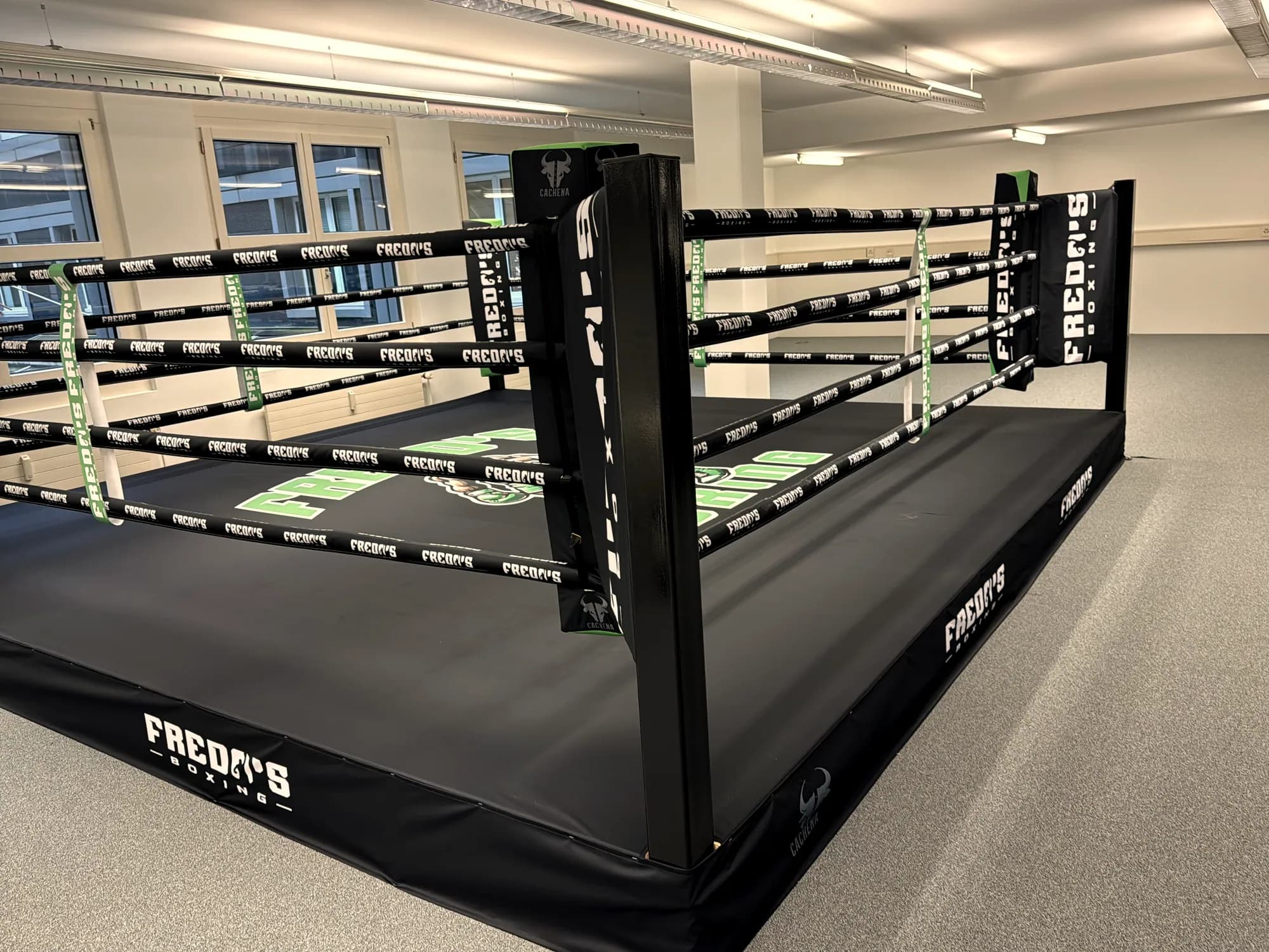
Training or competition: the first decision
Before you talk about dimensions, be clear about the purpose. A ring used only for training does not have to meet any rulebook. A ring intended for competition does. In Germany, Olympic-style boxing follows the competition rules of the German Boxing Federation (DBV). Internationally, World Boxing and the IBA set their own requirements.
The differences are not small. The DBV allows a roped square with sides between 4.90 and 6.10 metres. World Boxing requires at least 6.10 metres for its competitions. If you buy a training ring today and plan to host club bouts later, factor in the competition dimensions from the start. Converting a ring afterwards is almost always more work than planning it correctly.
- Will the ring be used only for training, or also for bouts?
- At what level: club bouts, regional championships or international events?
- Which disciplines will use the ring: boxing, kickboxing, Muay Thai?
- Will the ring stay in place, or does it need to be taken down and rebuilt?
- How many people will train in the ring at the same time?
Boxing ring dimensions: what the rulebooks say
The most important figure is the size of the fighting area inside the ropes. It determines how much movement is possible, and every other measurement follows from it. The table summarises the requirements of the three rulebooks.
| Feature | DBV (Germany) | World Boxing | IBA |
|---|---|---|---|
| Roped square, inside | 4.90 to 6.10 m | at least 6.10 m | 6.10 m |
| Total platform | no more than 7.80 m square | at least 7.40 m | 7.80 × 7.80 m |
| Apron beyond the ropes | at least 50 cm | at least 61 cm | 85 cm |
| Platform height | raised ring up to 1.25 m, championships at least 75 cm | 100 cm | 100 cm |
| Number of ropes | 3 or 4 | 4 | 4 |
| Rope thickness | 3 to 5 cm including padding | at least 4 cm, padded | 4 cm without cover |
| Rope heights | 3 ropes: 40, 80, 130 cm; 4 ropes: 40, 75, 105, 135 cm | 40, 70, 100, 130 cm | 40, 70, 100, 130 cm |
| Floor padding | 1.5 to 2 cm | 1.5 to 3.0 cm | 1.5 to 2.0 cm |
In day-to-day gym terms: a 6.10-metre roped square meets the World Boxing minimum and still falls within the DBV range. Smaller rings from 4.90 metres are permitted under DBV rules and often fit existing halls better. For training only, you can go smaller still, but the ring will then not be suitable for competition.
Please note: the DBV has rewritten its competition rules. The new version applies from 1 November 2026; the old one remains valid until 31 October 2026. The ring dimensions are unchanged. Some details have been clarified, for example the width of the straps that join the ropes: now 3 to 5 cm instead of 3 to 4 cm.
Boxing ring size in the room: more than the roped square
The footprint of a boxing ring is always larger than the fighting area. The platform extends beyond the ropes; under DBV rules by at least 50 cm on each side. A 6.10-metre roped square therefore needs a platform of at least 7.10 metres. The DBV maximum is 7.80 metres square.
You also need space around the ring: for steps, for coaches in the corners and, at events, for officials, the ringside doctor and spectators. For a raised ring, the DBV requires three sets of steps. One each serves the red and blue corners; the third is for the referee and the ringside doctor.
- Measure the hall including every column, radiator, window and door.
- Keep walkways and escape routes around the ring clear.
- Check that the components fit through doors, gates and stairwells.
- Position punchbags, mirrors and mat areas so the zones do not overlap.
- Plan lighting above the ring and power sockets for timers and music.
Raised ring or floor ring: choosing the height
The DBV distinguishes two types. In a raised ring, the fighting area sits on a platform whose floor is no more than 1.25 metres above the hall floor. Regional and national DBV championships must take place in raised rings with a platform height of at least 75 cm. World Boxing and the IBA require 100 cm for their competitions.
In a floor ring, the fighting area is at ground level. The corner posts are connected by a frame or anchored in the floor. Every part of the frame must be at least 50 cm away from the ropes. Here too, a non-slip, shock-absorbing floor of 1.5 to 2 cm is mandatory. Championships in any age group may not be held in a floor ring.
What the height means for your room
A raised ring needs ceiling height. Add the platform height, the height of your athletes and extra clearance for movement and lighting. With a low ceiling, a floor ring is often the better choice. For everyday training it is sufficient in many gyms.
- Raised ring: stage presence, suitable for competition, needs more space and ceiling height.
- Floor ring: easy access, good for daily training, not permitted for championships.
- Wall-mounted variants: save floor space, but are training-only solutions.
Ropes, corners and floor: the details behind safety
Under DBV rules, ropes are made of hemp or steel wire. They must be wrapped or covered, and steel wire must also be padded. The diameter including padding is 3 to 5 cm. The ropes are fixed to the corner posts with tensioning devices, which must not themselves pose a hazard. There must be at least 50 cm between the ropes and the posts.
Tension is a topic of its own. The DBV requires the ropes to prevent athletes from falling out as far as possible, without distorting the square. World Boxing is more specific: the top two ropes are tight, the bottom two less so.
All four corners are padded over the full height of the ropes. One corner is red, one blue and two are white, with red and blue diagonally opposite each other. The fighting area must be flat and level. On a raised ring, the padding is covered with a single-colour, non-slip canvas stretched without creases.
- Steel structure: clean welds, corrosion protection, stable corner posts.
- Tensioning system: adjustable, with no sharp edges or protruding parts.
- Padding: corner pads and rope covers sit firmly and do not slip.
- Floor and canvas: non-slip, shock-absorbing and replaceable individually.
Installation: subfloor, structural load, sequence
A ring on a platform transfers its load into the floor at specific points through posts and feet. Check with your landlord and, if needed, a structural engineer whether the floor can carry these loads, especially on upper storeys. If a floor ring is to be anchored, check beforehand whether drilling is permitted and whether pipes, underfloor heating or waterproofing are in the way.
- Survey the hall and fix the ring position.
- Check the subfloor, load capacity and fixings.
- Deliver the components and bring them into the building.
- Assemble the platform or frame, corner posts and floor padding.
- Tension the ropes and fit the corner pads and canvas.
- Check dimensions, rope heights and tension before first use.
The DBV competition rules valid until 31 October 2026 require the supervisor or referee to inspect the ring before every event. Boxing may not take place in a ring with defects. The new version requires in general terms that the ring endangers no one and allows bouts to run properly. For your gym, this means: without a properly installed ring, there are no bouts.
Branding, care and warranty
Many gyms use the ring as a branding surface. The DBV permits advertising on the ring canvas, corner pads, ropes and connecting straps, and on panels attached to the platform. The conditions: grip, padding performance and the officials' view must not be affected, and the corner colours must remain clearly recognisable at all times.
In daily use, the canvas, rope covers and pads wear faster than the structure. Check rope tension, bolted connections, pads and the canvas regularly for tears or creases. Before you buy, ask which parts the warranty covers and which count as wear parts.
Checklist: buying a boxing ring in eight steps
- Define the purpose: training, club bouts or championships.
- Identify the relevant rulebook and check the current version.
- Choose the roped square, between 4.90 and 6.10 metres under DBV rules.
- Calculate the space: platform, surrounding area, steps, escape routes.
- Choose the type: raised ring or floor ring, matched to the ceiling height.
- Clarify the subfloor and structural load with the landlord or an engineer.
- Specify ropes, pads, floor padding and branding.
- Agree installation, maintenance and warranty in writing.
How Cachena Sport helps
Cachena Sport builds boxing rings to measure in its own workshop near Ulm, made in Germany, and installs them on site. Founder Amer Osmanhodzic is a two-time European kickboxing champion and has worked in metal fabrication for more than 15 years. Across more than 500 projects, we have come to know the typical questions about space, height and installation.
- Initial conversation
- Consultation and situation analysis
- Defining the facility
- Production in our own workshop
- Delivery and installation
- Handover and maintenance
On request, we apply your branding to the canvas, ropes and corner pads. We give a 10-year warranty on the steel structures we manufacture ourselves. Wear parts such as pads, ropes, mats, floors and coatings are excluded. We deliver across Europe.
The current rules of the relevant federation always take precedence. The information in this guide reflects the status as of September 2026. If bouts are to take place in your ring, check the requirements with the responsible federation before you buy.
Planning a project?
We advise you on your space and how you will use it – usually within one working day.
Custom boxing ringSources
- German Boxing Federation (DBV): competition rules, in force from 1 November 2026 (German)
- German Boxing Federation (DBV): competition rules 2025, valid until 31 October 2026 (German)
- German Boxing Federation (DBV): new competition rules take effect on 1 November (German)
- World Boxing: Competition Rules, in force November 2024 (Rule 13.12 Boxing ring)
- IBA: Technical & Competition Rules, effective 3 March 2024 (Rule 43.2 Ring Specifications)